
India's ability to win a quick, pre-emptive war against Pakistan has just been enhanced by a useful new set of teeth.
India is deploying cutting-edge technology to defeat a simple insurgent weapon that J&K militants and Naxals are using to lethal effect: the Improvised Explosive Device, or IED. Swedish company Saab has offered to partner India's Defence Research and Development Organisation in fitting Saab's CARABAS radar on India's Dhruv Advanced Light Helicopter (ALH), which would allow the scanning of wide swathes of territory to detect IEDs well before they can be exploded.
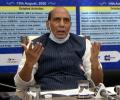
'The much-awaited decision could be a welcome change at a time when the Indian armed forces are crying for self-reliance and the defence industry is looking forward to more indigenisation,' notes Nitin A Gokhale.

An internet spy system -- Netra -- will help Indian security agencies decode messages sent by terror outfits like the Indian Mujahideen and Tehrik-e-Taliban on social media.
India succefully test-fired a 3,000-km Agni-III missile on April 12 this year.
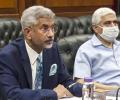
'Terrorism continues to be the overwhelming threat to security and stability in the SCO region and therefore Dr Jaishankar strongly pitched for 'collective action',' observes Dr Rajaram Panda.

India on Monday successfully test-fired its nuclear-capable Agni-II missile intermediate range ballistic missile, with a range of 2000 kms, from the Wheelers Island off Orissa coast.
India's indigenous Light Combat Aircraft Tejas has successfully completed air-to-air close combat missile firing tests, ahead of its clearance for induction into the Indian Air Force.
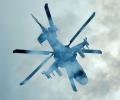
Russia -- already India's biggest arms supplier from 2014-18, accounting for 58 per cent of India's defence imports -- eyes more, reports Ajai Shukla.
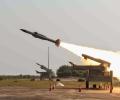
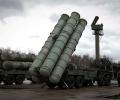
The missile system can target aircraft up to 30 km away, at altitudes up to 18,000 metres. It has the capability to neutralise aerial targets like fighter jets, cruise missiles and air-to-surface missiles.
K Santhanam, former Defence Research and Development Organisation scientist, who has rubbished the nuclear test at Pokhran in 1998 told journalists that he believed India neede to conduct two more tests to perfect the thermo-nuclear technology required to make a Hydrogen bomb. Santhanam maintained that simulations or computer-based tests were not enough to perfect thermo-nuclear technology. His statements are an antithesis of the Indian governments' position on this issue.

Another proposal of the army and the IAF for the procurement of 55 low level light weight radars was also cleared by the DAC for Rs 419 crore.

India on Friday successfully test-fired its indigenously developed sub-sonic long range cruise missile, 'Nirbhay' from the Integrated Test Range at Chandipur, Odisha.
Tie-up with MBDA will have Indian partner as majority shareholder; first product likely in 2 years.

An Indo-French proposed joint venture expected to be worth around Rs 30,000 crore to develop short range air defence missiles seems to have run into rough weather as Indian Air Force feels that its requirements could be met by indigenous Akash surface-to-air missile weapon system.
BrahMos is unique among cruise missiles due to its 2.8 Mach supersonic speed (all other cruise missiles are sub-sonic at present) and much-longer strike range.
In the midst of the controversy over the success of the 1998 thermonuclear test, nuclear scientist P K Iyengar has said the views of former Defence Research and Development Organisation scientist K Santhanam on the issue are the 'clincher'. There is a "strong reason to believe that the thermonuclear device had not fully burnt and, therefore, further testing was called for," Iyengar, a former Atomic Energy Commission chairman, said.
With a range of 25km, Akash is one of the five missiles currently under development by the Defence Research and Development Organisation.
Highly placed sources said the test firing could take place any time this month.
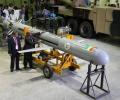
This was the fifth experimental test of the homegrown missile system.

India on Friday successfully test-fired its indigenously developed nuclear-capable surface-to-surface Prithvi II missile, with a range of 350 km, from a test range near Balasore as part of a user trial by the Army.
K Santhanam, a retired Defence Research and Development Organisation scientist, on Monday accused former Atomic Energy Commission chief Anil Kakodkar of 'ignoring facts' about the yield of the nuclear tests done at Pokhran in May 1998, calling him 'a liar' motivated by institutional loyalties.
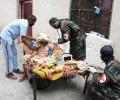
The military is 'totally prepared to stand up to the demands made by the government and the people.'
The Centre for Airborne Systems, DRDO's Bangalore-based unit, has revived the airborne early warning system programme, which was scrapped in 1999 following a crash of the rotodome radar-fitted Avro aircraft near Arakkonam in Chennai.

In fresh trials, India has test-fired its indigenously developed Nag anti-tank guided missile, which can hit a target up to seven km, from a helicopter at a firing range in Jaisalmer in Rajasthan.
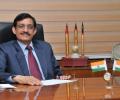
By removing Avinash Chander last week, the government has chosen to sacrifice the organisation's most potent symbol of success

Sushant Singh Rajput's father K K Singh alleged that Rhea Chakraborty is the "murderer" of his son and demanded her arrest.
Nishant, a remotely piloted vehicle (RPV) designed and developed by ADE, has an endurance of four to five hours and a range of 100 km in its primary roles. Flying at a speed of 40 to 60 metres per second, the UAV is capable of relaying data in real time to the army units moving forward in a battlefield condition.

Santhanam also sought to counter claims by Narayanan and others in the establishment that he was not privy to the test measurements and information on Pokhran-II tests.
Former Defence Research and Development Organisation scientist K Santhanam, who had questioned the success of the thermonuclear device during the Pokhran-II tests, has favoured an inquiry to determine the results of the 1998 experiments, saying creation of nuclear power could not be based on myths.

India has not only been decked in tricolour hues in the lead up to the 76th Independence Day celebrations, but also put under a heavy security blanket, right from Delhi, the epicentre of the mega celebrations, to Jammu and Kashmir.

When we look at the pension expenditure of the states, so far, there has been no gain from the NPS reform. Pension expenses as a share of total state revenue expenditure rose from 4% in 1991-1992 to 10% at the time of the NPS reform, and have risen further to about 12%, observes Ajay Shah.
India does not need to carry any more nuclear tests, Atomic Energy commission chief Anil Kakodkar said on Wednesday in the backdrop of the controversy over whether the 1998 Pokhran thermo-nuclear explosion was a fizzle.
'There is a change in the administration in the United States of America. They are bound to further pressurise India to sign the CTBT. In such an event it was necessary to make such a statement or speak the truth on the issue so that India does not rush into signing the CTBT.'
The scientific adviser to defence minister said the Defence Research and Development Organisation will be building the vehicle in about 30 months.

Chaos prevailed outside a newly-inaugurated 900-bed Covid-19 hospital in Ahmedabad as people flocked there in large numbers since early morning on Thursday with the hope of securing admission for their ailing family members and relatives.
